

Initially computers were complete and relatively closed products developed by individual manufacturers, which designed and produced all of their key components while also managing every aspect of their maintenance and use. The first significant departure from this production approach was brought on by minicomputers. Manufacturers no longer required an entirely original hardware or software design. Instead, they could combine various readily available minicomputer components into a functioning system, make their own modifications and market it under a new brand name. Electronic components, software, and other parts, such as their housings, could originate from entirely different industrial and design environments. The DEC PDP-11 minicomputers are a good example, since they were well established in Slovenia through locally produced variants manufactured by the company Iskra Delta.
With the advent of microcomputers this new production approach was further refined. The development of readily available microprocessors, different memory and controler chips, as well as hard-disk and floppy-disk drives and other compatible components, enabled even small companies with no prior experience in the field to begin producing their own microcomputers. Entry into the industry became considerably easier, however, manufacturers lost a substantial degree of their independence. Success of their products largely depended on effective advertisting and positioning in an increasingly saturated market. In addition to integrating readily available components into a complete product, local adaptations and high-quality technical support became increasingly important. This production approach was consolidated by the introduction of the IBM PC microcomputer, which, contrary to the company’s traditional practice, was designed as a more open product assembled from components manufactured by different suppliers.
Microcomputer Partner
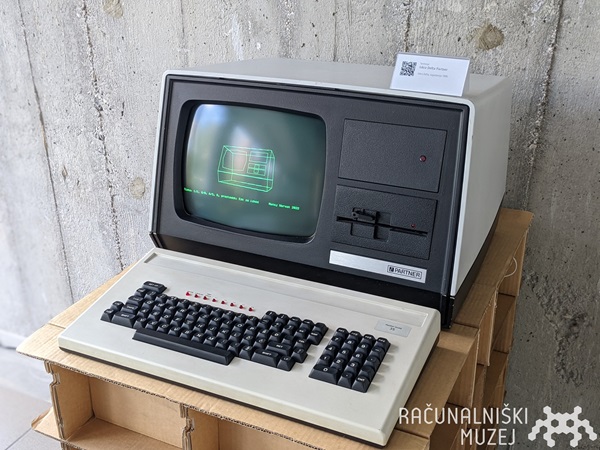
The Iskra Delta Partner is regarded as the most successful Slovenian microcomputer. It represents one of the earliest and most significant domestic attempts to develop and mass-produce computers. In fact, it was a domestic version of a well established type of microcomputer based on integrated circuits from the Zilog Z80 family and the CP/M operating system. However, Partner was not merely a copy of better known foreign computers. It was a result of smart integration of internationally available technological solutions and approaches with domestic development and adaptations. Today, it serves as a valuable example for examining the changes in computer manufacturing brought on by mini and microcomputers. The Computer Museum’s collection contains five Partner computers from different time periods. During routine examination and restoration, we asked ourselves: Where did their distinctive computer case actually originate from and what can it tell us about the computer industry of the 1980s? While attention is usually focused on main functional units, the external appearance of a device can also reveal much about how an international network of manufacturers and designers contributes to the creation of products that we recognize as distinctly domestic.

Microcomputer Partner. Wolfgang Stief on Flickr. (CC Public domain)
In 1983, the newly merged Iskra Delta company sought to immediately establish a strong presence on the domestic market by introducing a competitive, mass-produced computer. The Partner microcomputer was designed for a broad range of users, including businesses, institutions, and schools. Since the company still possessed relatively limited in-house production capabilities, it had to rely on foreign suppliers and components. The printed circuit boards were manufactured to order in Italy, while the distinctive enclosures were produced in England. In Ljubljana, the printed circuit boards were fitted with electronic components and tested, then installed into their housings together with the display unites. The computer also required a suitable domestically produced firmware (BIOS) to run the popular CP/M 2.2 operating system and well-established business software.

Later version Partner in original computer case. Computer museum in Ljubljana.
In addition to the first business version of Partner, two later versions were developed. The second, graphical version, released in 1985, was an enhanced version od the first one, equipped with a basic graphics controller and a local-area network (LAN) controller. It belonged to the Triglav family of microcomputers and terminals, distinguished by a highly characteristic and ergonomic computer case designs, created by Vid Brataševec at the Mak design studio in Koper. The design received an industrial design award. The third version of Partner, released in 1987 was compatible with IBM PCs. It was an entirely different type of microcomputer, based on integrated circuits from the Intel 80286 family and the MS-DOS operating system. It was sometimes marketed as a workstation. The computer was housed in a characteristic horizontal desktop case with a separate monitor on top. The design matched that of the other computers and terminals in the Triglav family.
Manufacturing aspect
In the Computer Museum’s laboratory, we focused particularly on the first version of Partner. Initially, we were unable to find any information online about its computer case. Conventional searches mainly returned well-known photographs of computers, but provided no information about the designer, the manufacturer, or the name of the product itself. We therefore approached the investigation from a different direction. We found the first important clue when we opened the cases of our Partner computers. We discovered a manufacturer’s stamp on the inside. This led us to the English company Peerless Foam Moulding, which manufactured plastic products. Its successor later operated under the name Tamworth Mouldings Limited. For the first time, the investigation thus moved beyond speculation about the origins of Partner’s computer case and toward a specific company and production environment.

Manufacturer’s stamp in Partner’s computer case. Computer museum in Ljubljana.
The stamp itself, however, did not reveal the complete story. Although the English design register contains several historical entries associated with Peerless Foam Moulding [link], we were unable to find an entry corresponding to the Partner’s computer case. This meant that we once again had to look for other clues. In this type of research, even the smallest detail can sometimes prove decisive, so we undertook a more systematic examination of the available photographs. One particularly interesting result was the Logitech LG-10 computer, preserved at the Bolo Museum in Switzerland [link]. Its computer case is identical in design to that of Partner, although it was produced in a different colour. It is a very rare computer and a valuable discovery, as it demonstrated that the computer case was not associated exclusively with a single manufacturer or market. Someone even installed an Apple II computer in the same case [link]. Most likely, this was a Linotype-Paul APL 100/200 [link], which one collector presented on YouTube [link], noting that it was a hybrid of the Apple II and Partner computers. The only connection between the two is, of course, the computer case! This nicely illustrates the nature of such components for secondary manufacturers. They provided an external form/design into which various computer systems could be installed. We also discovered the corresponding monitor [link] and keyboard [link] cases, designed in the same stylistic manner. The design was therefore part of a broader product line and was not necessarily developed specifically for Iskra Delta. Rather, it formed part of a pre-designed product system made available to different customers.

Microcomputer Logitech LG-10. Rama on Wikimedia. (CC BY-SA 3.0)
The manufacturing technology used is also significant. The company’s housings were produced using a process that was relatively new at the time and known as Cinpres or Controlled Internal Pressure [link]. They used various structural foams before, such as high-impact polystyrene (HIPS) mixed with a chemical blowing agent. However, the surfaces of products manufactured in this way were often relatively coarse and therefore had to be sanded and painted after production. The development of the Cinpres process was intended specifically to eliminate these problems. Nitrogen was injected into the molten polymer, thereby creating hollow sections within the product. This made it possible to manufacture a lightweight and space-efficient component while also achieving a higher-quality moulded surface that no longer required additional painting. The process was patented and marketed by Cinpres Limited. The patents are now administered by Cinpres UK. The technology has naturally continued to evolve and is currently used in the automotive industry, the domestic-appliance industry, consumer electronics industry, and the manufacture of plastic furniture. This detail is particularly interesting, because it confirms that the Partner’s computer case was the result of a specific and technologically advanced manufacturing process at the time, rather than merely a generic plastic product without a broader history.
Designing aspect
The search for documentation concerning the company that designed this particular computer case was initially unsuccessful. Inquiries made with former employees of Peerless Foam Moulding also failed to produce any useful information. A turning point was the discovery of the company Summit Systems [link]. The director of Summit Systems and his brother have previously worked for Peerless Foam Moulding and were familiar with the design studio responsible for the industrial design of this particular computer case. This led us to Satherley Design Associates, which was managed throughout its existence by Richard Satherley. Satherley had a long history of designing technological products, and some them are now also documented and preserved in museum collections [link]. The most important step followed when, through LinkedIn, we came across Mr. Peter Bessey, a former associate of Satherley Design Associates. He had worked with the company during its early years and explained that the housings had been marketed through the catalogues of BICC-Vero Electronics. He had even preserved a copy of a catalogue containing drawings and photographs of different housings.
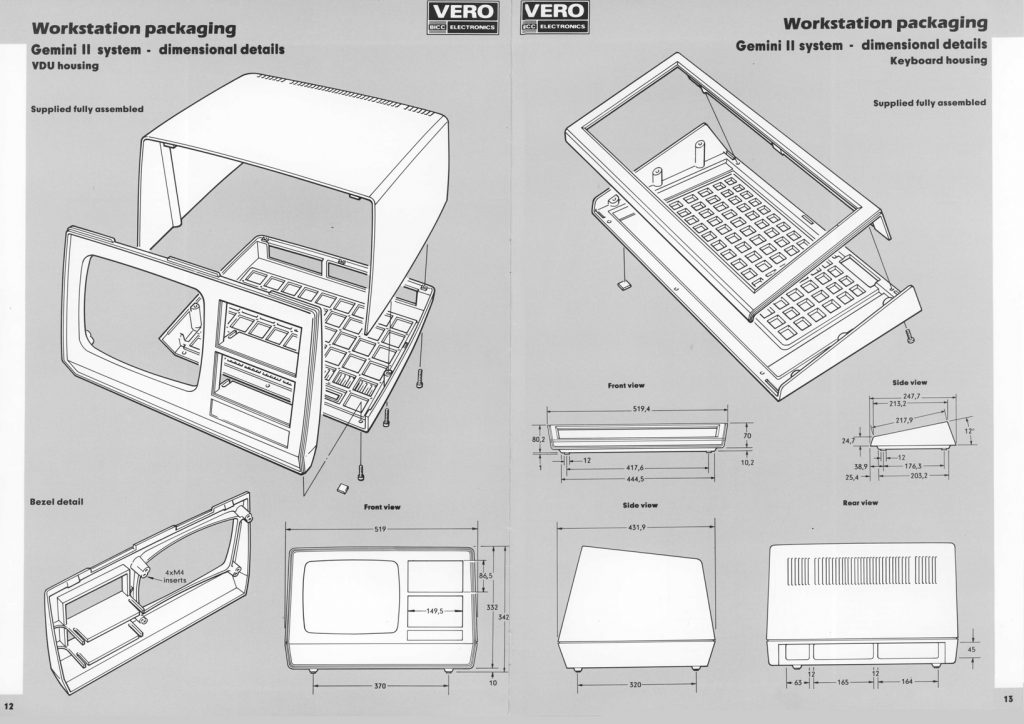
Catalog entry kindly provided by Peter Bessey. (All rights reserved, BICC-Vero Electronics)
When we received scans of a catalogue from him, we were able to compare the documented housings directly with the computer case of the Partner computer. In the catalogue, the product is identified as the Gemini II. The two housings correspond completely in terms of their shape, arrangement, and distinctive openings. The name Gemini supposedly referred to the two openings on the right-hand side of the video display unit, intended for floppy-disk or hard-disk drives. Partner was available in three versions featuring one or two floppy-disk drives or a hard-disk drive. It is not entirely clear whether the Partner’s computer case was marketed as the Gemini II or whether it was a variant or a second generation of the product. It is possible that the Gemini I was not used for the Partner, while the appearance of the second version corresponds exactly to the computer case known from Slovenian computer history. Definitive confirmation would require additional documentation. Nevertheless, we now have a solid basis for establishing a connection between the Partner, the Gemini II enclosure, BICC-Vero Electronics provider, and the Satherley Design Associates design studio. We also contacted Verotec, the successor to BICC-Vero Electronics, for further information and documentation, but unfortunately we were unable to obtain any new data.

Catalog entry kindly provided by Peter Bessey. (All rights reserved, BICC-Vero Electronics)
Preservation aspect
The findings of this research are important not only for the understanding of the Partner computer. They demonstrate how computer products were developed during the 1980s. At the same time, they remind us that even a seemingly well-known and mass-produced computer can still reveal an entirely new chapter. There are many Partners in Slovenian collections, yet their individual components continue to hold undiscovered secrets. These secrets are not preserved in archives, instead, they await discovery on the inside of a housing, in a forgotten catalogue, or in the memory of someone who was involved in the project decades ago. For us, as computer enthusiasts, this is precisely the best part of research, the moment when the individual fragments finally come together to form a coherent story. The computer case, which until now we had known primarily by its appearance, now also has a name, a production context, and the people responsible for its design. Considering the age of the computer, the companies, and the individuals involved, it was high time that these findings came to light.
The Partner computer continues to exist today in different other forms. Three emulators are already available, allowing everyone to recreate part of the original user experience: emulators developed by Matej Horvat [link], Miodrag Milanović [link] and Tomaž Štih [link, link]. Matej’s emulator, together with a selection of old and new games, can be tested from a web browser [link]. At present, however, the keyboard does not function on mobile devices, so a computer is more suitable for best experience. At the museum, we have also archived the contents of the read-only memories (ROMs) from our Partners, thereby preserving another important part of its software [link]. Miha Grčar from the Oddbit Retro community [link] has also produced entirely new motherboards and graphics cards for the Partner based on the original printed circuit boards [link, link]. This is the only way to preserve the computers if their original components become irreparable. As part of domestic computer culture, Partner also appears outside museums and computer workshops. It is not merely a museum object from the past. It remains a starting point for new forms of research, recreation, and remembrance, as demonstrated by the Partner-themed T-shirts produced by BREG Design [link].
This article is dedicated to Mr Richard Satherley, who recently passed away and whom, unfortunately, I never had the opportunity to meet.
Addendum (25th of September 2026)
Following the publication of the article, we received further clarifications and additional information regarding our findings. Many thanks to everyone who wrote to us!
It turns out that two different Apple II variants share the same case, having been repackaged into it by two separate companies for distinct purposes: the Linotype-Paul APL 100/200—which we have previously written about—and the “Acclaim” computer from the English company Country Computers [link]. We found a wonderful black-and-white drawing in the Windfall magazine that depicts this case in a new way. We would like to thank Mr. Roger S. for the information.

But the discoveries didn’t stop there! With every new photo of the “Gemini” case, we could try searching again using Google Lens. Many computer cases from the 1980s look similar, but the details reveal that it is not the same case used for the Partner. However, we believe we also spotted it in a photo of the Nascom-C computer from an advertisement featured in a Hackaday article [link].
A second update corrects our earlier statement that the case was manufactured using the Cinpres process. Mr. Steve Jordan clarified that this process only came into use two or three years later; prior to that, Peerless Foam Moulding manufactured computer cases using older methods that required sanding and painting to achieve a high-quality finish.
The final correction concerns the manufacturing process of the Partner computer at Iskra Delta: Mr. Jože Stepan informed us that the printed circuit boards were not populated with components in Ljubljana, but rather in Kranj.