


Origin of the Future
ORIGIN OF THE FUTURE_ 50 years of artificial inteligence development in Slovenia
The exhibition Origin of the Future offers an in-depth look into the past half a century of artificial intelligence development in Slovenia, showcasing the country’s rich history of innovation in this field. The exhibition was on display from April 3 to May 3, 2026, at the Kresija Gallery in Ljubljana.
The tale of the beginnings of technology that has now found its way into nearly every part of our society, is told through memories and video testimonies of Slovenia’s leading AI pioneers: Ivan Bratko, Nada Lavrač, Franc Solina, Igor Kononenko and others. Visitors can try out interactive exhibits and learn more about the questions the scientists faced through the eras of research.
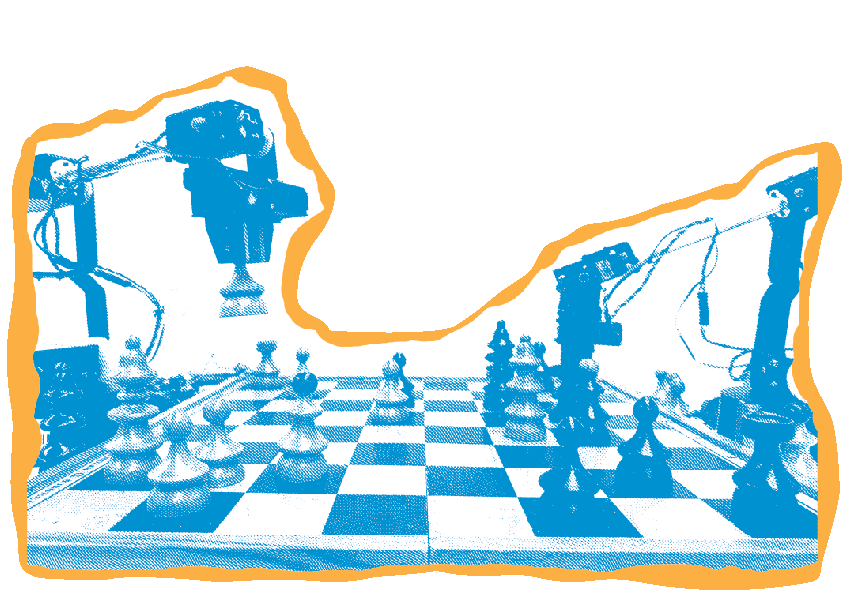
“The story starts in September 1970. Three recent electrical engineering graduates, Iztok Lajovic, Vladislav Rajković and me [Ivan Bratko – Ed. note], visited Dr. Anton Železnikar, head of the E4 department at the Jožef Stefan Institute. We expressed our wish to work there and asked what we could do.
Dr. Železnikar was very open-minded. Within the first few minutes, our conversation shifted to artificial intelligence. We had heard of this field and thought it interesting. That was enough.
We were assigned the unfinished attic rooms that had no windows; it was hot in the summer and freezing cold in the winter. It was nonetheless exactly this attic that later became home to bigger departments that studied AI. We were soon joined by Peter Tancig. But when it came to the actual expertise in the field of artificial intelligence we were on our own. We had access to the library, some academic papers and books, but that was it,” recalls Dr. Ivan Bratko.

Ljubljana’s school of artificial intelligence
New breakthroughs and discoveries rarely happen in isolation. Slovenian scientists earned their doctorates from top international universities, building bridges for international collaboration of future generations. Through global networking and hosting events aimed at exchanging ideas, Slovenia was established as the hub for the European AI community and a global center for machine learning, inductive logic programming and relational learning. Many foreign scientists wanted to collaborate with our institutes, where foundational works were being made, works that are being cited worldwide in new research.
The Slovenian approach to AI became so recognizable that it earned the name Ljubljana’s school of artificial intelligence in the Turing tradition. It is based in logic, it is not a black box that only gives results, but rather it searches for logical rules, which humans can understand. By leveraging the prior domain knowledge of experts, it has practical applications in various scientific fields (biology, chemistry and discovery of new scientific laws).
The exhibition was prepared by the Computer History Museum in collaboration with the Faculty of Computer and Information Science of the University of Ljubljana, the Slo AI Institute for the Promotion of Artificial Intelligence Development, the Slovenian Artificial Intelligence Society (SLAIS), and the Jožef Stefan Institute.
The main sponsor of the exhibition is the leading global technology company Sportradar, that uses artificial intelligence in the field of sports data solutions and analytics, partnering with the world’s largest sports associations and leagues (UEFA, NBA, NHL…). With their support to this project, Sportradar contributes to the recognition and advancement of artificial intelligence, and fosters the connection between science, technology and society.
Strategic partners of the exhibition are NLB and Telekom Slovenia, which also provided the technology that enabled automatic subtitling that enhanced the exhibition’s accessibility.
Sportradar is a leading global sports technology company creating immersive, data-driven experiences for sports fans and betting audiences worldwide.
Founded in 2001, Sportradar bridges the sports, media, and betting industries with modern technology solutions. We have partnered with leading organizations such as the NBA, ATP, NHL, MLB, FIFA, UEFA, Bundesliga, and many others, covering nearly one million sports events annually.
Our teams are shaping the future of sports engagement, backed by strong industry relationships and a commitment to integrity through our Integrity Services division.
Our Ljubljana office is one of Sportradar’s key strategic technology hubs and home to some of our largest Artificial Intelligence, Computer Vision, and Data Science teams. Here, we develop the core technologies for our global sports insights, ranging from computer vision and predictive models to real-time sports understanding.
Ljubljana plays a pivotal role in developing our next-generation sports technology, making it an exciting environment for engineers, researchers, and innovators looking to build the future of sports.
The Faculty of Computer and Information Science of the University of Ljubljana is the leading Slovenian academic institution representing the field of artificial intelligence and the yearslong home of the pioneer of AI in Slovenia, dr. Ivan Bratko.
Research groups in numerous laboratories are working on machine learning and artificial intelligence:
Slo AI Institute for the Promotion of Artificial Intelligence Development is a community of AI enthusiasts, experts, and entrepreneurs in Slovenia. Through its program, it enables knowledge sharing, accelerates the adoption of artificial intelligence across various industries, connects engineers with companies as well as entrepreneurs with investors, and contributes to the digital transformation of Slovenia.
SLAIS (Slovenian Artificial Intelligence Society) is an association of researchers and professionals in the field of artificial intelligence in Slovenia. While the majority of its members come from universities and research institutes, the society also includes experts from industrial and commercial organizations. The society promotes theoretical and applied research, as well as the transfer of artificial intelligence technologies into industrial and business environments. SLAIS was founded in 1992 and is a member of the European Association for Artificial Intelligence (EurAI).
The Jožef Stefan Institute is the leading Slovenian scientific research institute and the place where AI research in Slovenia has its roots. There informal activities began as early as 1970, and the first formal research group in the field was established in 1979. Today, approximately 200 experts at IJS work on artificial intelligence, and their work is internationally recognized.
The mission of the Jožef Stefan Institute is to create, spread and transfer knowledge in the fields of natural sciences, engineering, and life sciences.